
How Many Minutes Should a Cat Exercise Each Day?
10% off on product page · save $27.22
How Many Minutes Should a Cat Exercise Each Day?
How Many Minutes a Day Should a Cat Exercise?
Most adult cats should get about 20 to 30 minutes of active exercise each day. Divide that time into two or three sessions lasting 5 to 15 minutes, since cats typically prefer short bursts of movement over one extended workout.
Age, health, weight, and temperament can change this target. Kittens may play for an hour or more throughout the day, while senior cats may need several gentle 5-minute sessions. Learn more in the complete guide to daily cat exercise.
Set a Practical Daily Schedule
Schedule one play session in the morning and another in the evening, when many cats are naturally more active. Start with 10 minutes per session and use a timer to maintain a consistent routine.
If your cat loses interest after five minutes, stop and try again later rather than forcing continuous activity. Record each session for one week to determine whether your cat consistently reaches the 20-minute minimum.
Featured in this guide
Cat Exercise Pack for a Vibrant, Active Lifestyle – 3-in-1 Bundle of Cat Exercise Checklists
Use a Wand Toy in Short, Measured Sessions
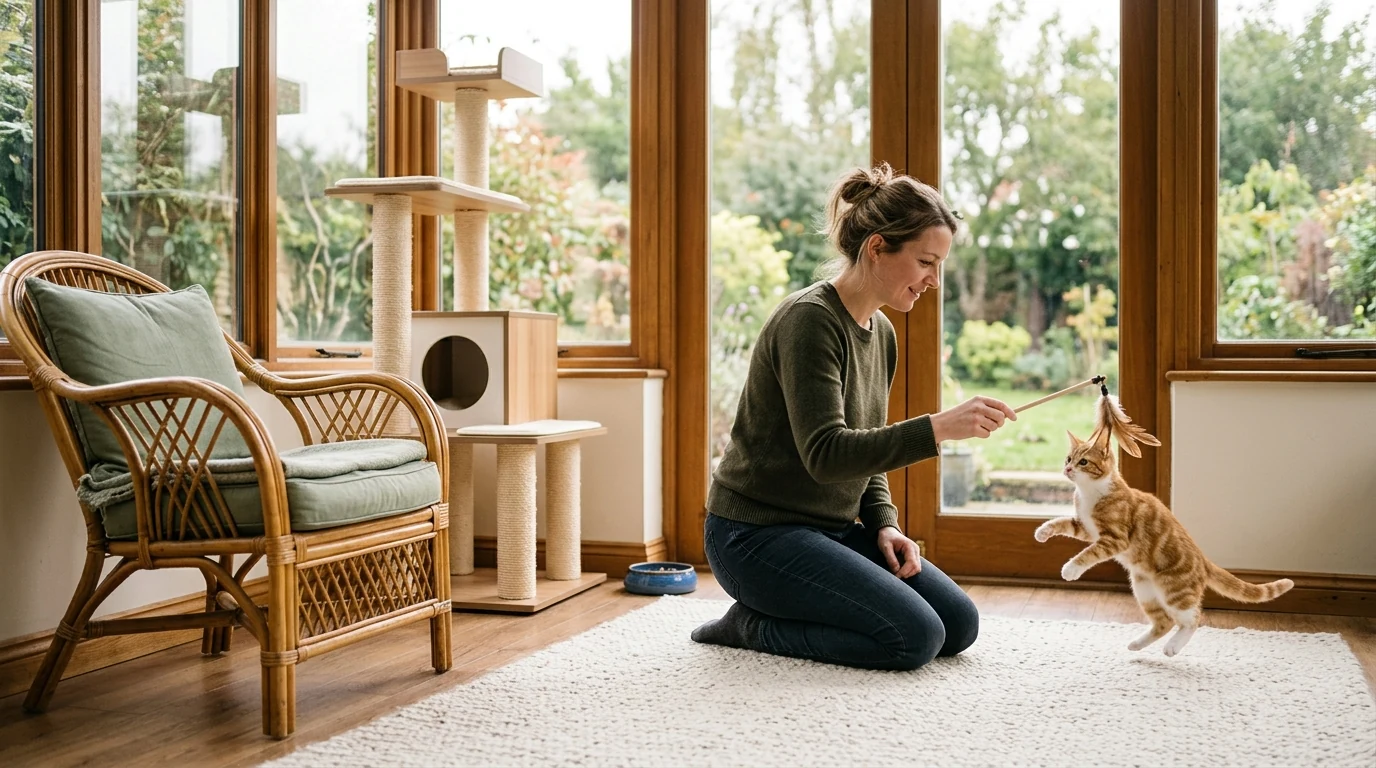
Choose a wand toy with a flexible rod and securely attached fabric or feather lure. Move it along the floor, around furniture, and onto a stable platform to encourage running, turning, and climbing for 5 to 10 minutes.
Allow your cat to catch the lure periodically, then inspect the cord and attachments for fraying. Store string-based toys after use because loose cords can present an ingestion or entanglement risk.
Add Vertical Movement Safely
A stable cat tree can add climbing to an indoor cat’s exercise routine. Check that the base does not rock and that each platform comfortably supports your cat’s full body length and weight.
Place a toy or small treat on progressively higher levels to prompt controlled climbing. For seniors or cats with limited mobility, use low platforms spaced close enough for stepping rather than jumping.
Adjust Exercise for Health and Age
Overweight cats should begin with two or three 5-minute sessions and increase activity gradually. Low-impact options, such as rolling a lightweight ball across a nonslip floor, reduce stress while still encouraging movement.
Stop if your cat pants, limps, coughs, or appears distressed. Ask a veterinarian for an appropriate exercise duration if your cat has arthritis, heart disease, breathing problems, or a recent injury.
“The checklists are so easy to use, even for a newbie like me.”
FAQ
How do I know if my cat is getting enough exercise?
A cat getting enough exercise generally maintains a healthy weight, moves comfortably, and settles calmly after play. Track at least 20 minutes of daily activity and consult a veterinarian if your cat gains weight, becomes unusually restless, or struggles with normal movement.
How do you exercise a lazy cat?
Exercise a lazy cat with brief 3- to 5-minute sessions using a wand toy, rolling ball, or treat puzzle. Try sessions before meals, rotate toys every few days, and reward even small amounts of movement without forcing activity.
Do indoor cats get enough exercise?
Indoor cats can get enough exercise, but their environment must encourage daily movement. Without opportunities to chase, climb, scratch, and explore, they may become inactive and gain excess weight. Most healthy adult cats benefit from at least two or three focused play sessions each day, lasting about 10 to 15 minutes each.
See if Cat Exercise Pack for a Vibrant, Active Lifestyle – 3-in-1 Bundle of Cat Exercise Checklists fits your setup













Leave a comment