52% off on product page · save $88.48
What Are Actual Montessori Toys? Key Traits and Examples

Actual Montessori toys are play materials that reflect Montessori principles: they invite children to explore independently, practice a meaningful skill, and learn through hands-on experience. Rather than entertaining a child with flashing lights or automatic actions, a Montessori-aligned toy gives the child something to do, such as grasp, fit, stack, sort, or open.
There is no universal certification that makes a toy Montessori, and a wooden toy is not automatically Montessori simply because of its material. Look instead at how your child can use it: the activity should be understandable, appropriate for their development, and open to repeated practice without an adult directing every move.
For a baby, a simple grasping toy or an age-appropriate object that can be moved from one hand to the other can offer an opportunity for exploration. As children develop, a stacking activity, shape sorter, or object permanence box can provide a clear task with a visible result.
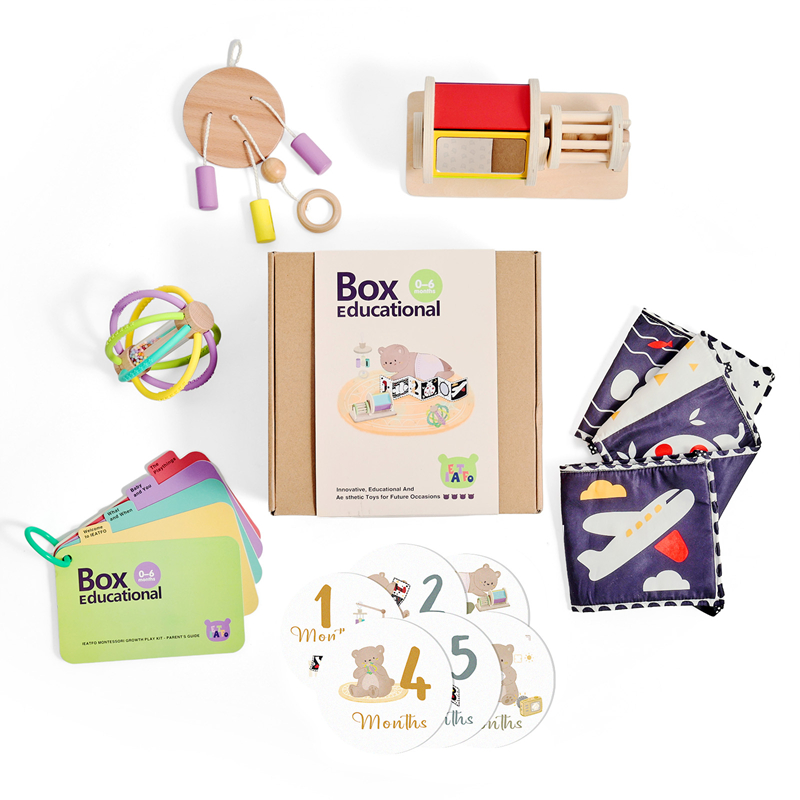
Practical materials can fit the approach, too: a child-sized pitcher for pouring or a set of containers to open and close connects play with everyday life. Our Montessori Wooden Baby Toy Set play guide is a starting point if you are exploring this style of play for a baby.
Check the product’s listed specifications when evaluating examples of montessori-aligned toys.
Featured in this guide
Montessori Wooden Baby Toy Set
Choose an activity that matches what your child is ready to try, rather than relying on the Montessori label alone; a toy that is too difficult may need to wait, while one they can manipulate gives them room to practice. Offer it on a low, accessible shelf or a clear play surface, demonstrate briefly if needed, and let your child decide how long to explore.
For babies and toddlers, avoid small detachable pieces that could be choking hazards, and inspect toys regularly for splinters, loose parts, or damaged finishes. Clean each toy according to its material and the manufacturer’s care instructions, and supervise play in a way that suits your child’s age and the activity.
A toy fits the Montessori approach when its design lets a child actively explore or practice a skill with minimal adult direction. Its purpose and suitability for the child matter more than whether it is made of wood or marketed as Montessori.



Leave a comment